
What AI structuring does and does not do in radiology reporting
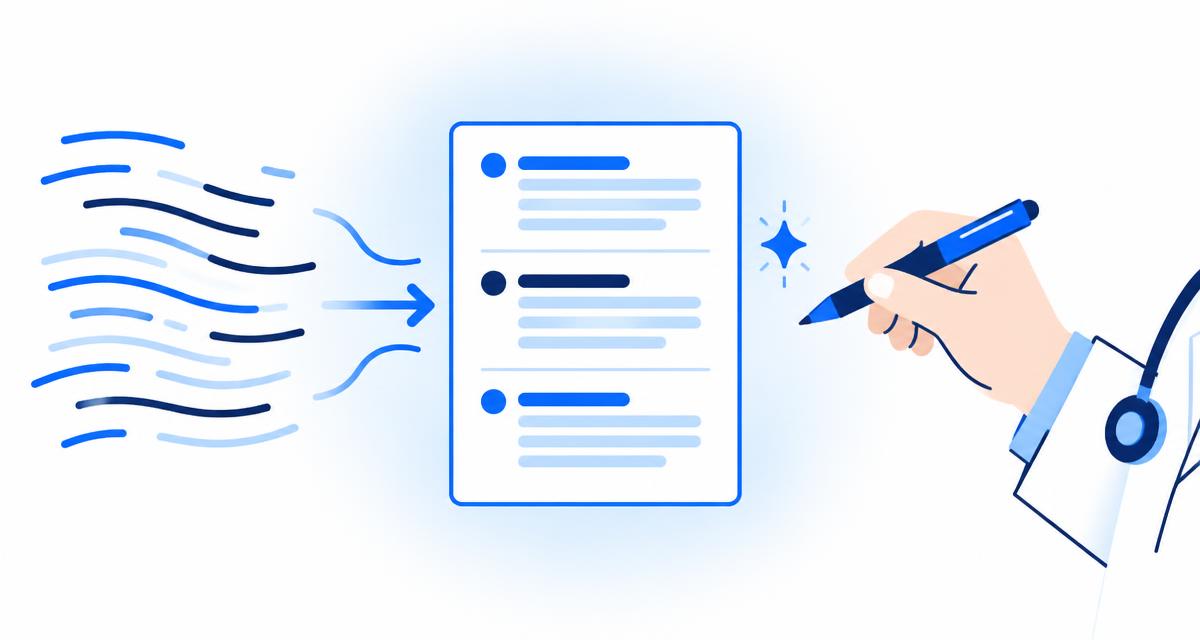
Artificial intelligence is discussed a great deal in radiology, and the term covers very different things. Some tools analyse images. Others work only with text. This guide is about the second kind: tools that take a radiologist's dictated words and arrange them into a structured report.
It explains what that kind of structuring does, what it should never do, where its limits lie and how to review its output. It is not about image interpretation, and it makes no claims about diagnostic performance, because text structuring does not diagnose anything.
What is AI structuring in radiology reporting?
AI structuring is the use of a language model to take free dictated text and arrange it into report sections, such as Indication, Findings and Conclusion. The input is the radiologist's own words; the output is the same content, organised.
A radiologist might dictate a study in a natural, slightly unordered way, mentioning the clinical question, then a finding, then a technical point, then another finding. Structuring places each sentence or phrase under the right heading and tidies punctuation so the draft reads cleanly.
It is a formatting task. Done properly, the structured report should contain nothing that the radiologist did not say.
- Input: the radiologist's dictated text.
- Output: the same content arranged into sections.
- Purpose: easier reading and quicker review.
What does AI structuring do well?
AI structuring does well at recognising which part of a dictation belongs in which section and at tidying spoken language into readable sentences. These are tasks that take a person a few minutes of cutting and pasting but follow clear patterns.
It can handle dictation that jumps between topics, separate the clinical question from the findings, and bring conclusion statements together at the end. It can also fix obvious spoken artefacts, such as repeated words or missing full stops, without changing meaning.
The result is a draft that is quicker to check, because each section can be reviewed on its own and compared with the original transcript.
- Sorting sentences into the right sections.
- Tidying punctuation and capitalisation.
- Removing repeated words from spoken dictation.
- Producing a consistent layout for every report.
What should AI structuring never do?
AI structuring should never add findings, measurements, laterality or conclusions that the radiologist did not dictate. Anything new in the output is a fault, however plausible it looks.
Language models are good at producing fluent, likely sounding text, and that strength becomes a risk if they are allowed to fill gaps. A model might, for example, add a side to a finding, round a measurement or write a conclusion that seems to follow from the findings. None of these are acceptable in a structuring tool.
A well designed tool constrains the model tightly: it instructs it to reformat only, limits the output to fixed sections and gives the radiologist ways to spot anything that does not match the transcript.
- No new findings.
- No new or changed measurements.
- No added left, right or bilateral.
- No conclusions the radiologist did not state.
- No softening or strengthening of the radiologist's wording.
Does AI structuring interpret images or make a diagnosis?
No. AI structuring works only with the text of the dictation and never sees the images, so it cannot interpret them or make a diagnosis. All clinical judgement comes from the radiologist.
This is an important distinction. Image analysis tools are a separate category with their own evaluation and approval processes. A structuring tool is closer to a careful editor than to a second reader.
Medicate structures dictated text; the physician reviews and signs every report. It is not a diagnostic tool.
What are the limits of AI structuring?
The main limits of AI structuring are that it can misplace sentences, misread ambiguous phrasing and, despite instructions, occasionally alter wording. It can only be as good as the dictation it receives.
If a sentence could belong in either the findings or the conclusion, the tool has to choose, and it may choose differently from the radiologist. If speech recognition has misheard a word, structuring will carry that error into the draft. And because language models are probabilistic, the same input can produce slightly different output on different occasions.
These limits are why structured output is always a draft. It should be reviewed against the transcript and corrected before signing, every time.
- Sentences can be placed in the wrong section.
- Ambiguous phrases can be read differently.
- Speech recognition errors are carried through.
- Output can vary slightly between attempts.
How should you review AI-structured text?
Review AI-structured text by comparing it with your original transcript, section by section, paying close attention to laterality, numbers, negations and the conclusion. The question to ask is not whether it reads well but whether it says exactly what you said.
Medicate shows the structured report next to the raw transcript and highlights left, right, bilateral and numbers that appear in the draft but not in the transcript. These highlights are a prompt to look, not a guarantee; a full read is still needed.
Corrections should be literal. In Medicate, voice and typed commands such as "replace mild with moderate in findings" swap only the words you name, without using AI, so the correction step cannot introduce new content.
- Compare each section with the transcript.
- Check every laterality word and number.
- Confirm negations have not been lost.
- Make sure the conclusion matches your own.
How can you tell if a structuring tool is well designed?
You can tell a structuring tool is well designed if it keeps your words, shows its output next to your original text, makes differences easy to spot and never lets you sign without reviewing. Transparency matters more than polish.
Try it with a dictation you know well and compare the result line by line. Check whether hedges such as "likely" or "cannot be excluded" survive, whether numbers are copied exactly and whether anything appears that you did not say. Try an ambiguous dictation too, and see how the tool handles it.
- Output can be compared with the transcript side by side.
- Your qualifiers and hedges are preserved.
- Numbers and sides are copied exactly.
- Corrections do not rely on further AI rewriting.
- Signing is a separate, deliberate step.
Who is responsible for a structured report?
The radiologist who signs the report is responsible for its content, whether or not a tool helped arrange it. Structuring is an aid to presentation, not a transfer of responsibility.
This is why signing should be a deliberate step that comes only after review. A good workflow makes it easy to see what has changed, easy to correct it and impossible to sign without having the draft in front of you.
In Medicate, a report stays a draft until you sign it on the Sign step, where you choose the referrer and add your signature before downloading the file.
Frequently asked questions
Does AI structuring look at the images?
No. It works only with your dictated text. It cannot see images and does not interpret them.
Can AI structuring add findings to my report?
It should never do so. Medicate instructs the model to reformat only and highlights laterality words and numbers that are not in your transcript, but you must still review the draft.
Are corrections in Medicate made by AI?
No. Correction commands use a simple literal parser that replaces or deletes only the exact words you name.
Is a structured draft ready to send?
No. A structured draft must be reviewed, corrected where needed and signed by the radiologist before it is used.
Medicate is a demonstration product. All data on this site is fictional.